
The Future-State Customer Journey is the Blueprint for Enterprise Transformation
The strongest enterprise transformation roadmaps are built by analyzing the gap between the current customer journey and the future-state experience, then defining the enterprise changes required across technology, process, governance, and the overall operating model. The quality of that roadmap depends on how well leaders interpret customer signals, operational constraints, technology realities, and business priorities.
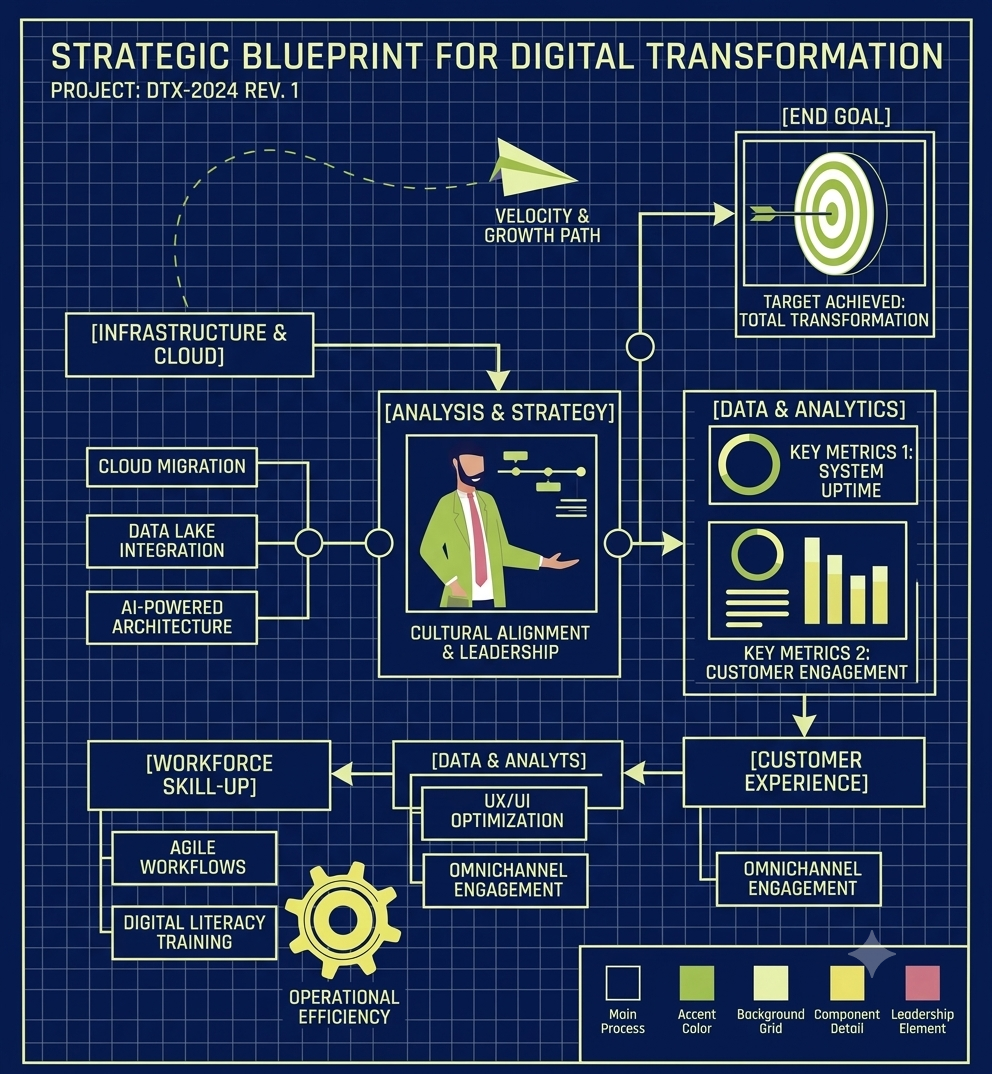
Digital Transformation
Align on Transformation Goals
Enterprise transformation initiatives are often launched to improve business performance, reduce costs, modernize technology, improve customer experiences, respond to competitive pressures, or support long-term growth. While the specific drivers may vary, leaders should first align on the outcomes the transformation is intended to achieve and the measures that will define success.
Establishing a shared set of goals creates a common foundation for decision making throughout the transformation effort. It helps guide current-state assessments, informs future-state design, and provides a framework for evaluating capabilities, technology investments, operating model changes, and implementation priorities. Without this alignment, organizations may struggle to prioritize opportunities, evaluate tradeoffs, or determine whether transformation investments are delivering the intended results.
Common transformation goals include improving customer satisfaction, increasing operational efficiency, accelerating growth, strengthening employee experiences, reducing risk, modernizing technology, and creating competitive advantage.
Start With the Current-State Journey
A strong future-state journey begins with a disciplined understanding of the current customer experience, including identifying where customers experience confusion or expend unnecessary effort.
Transformation teams will evaluate where customers …
Get stuck today
Are asked to repeat information
Abandon the experience
Wait too long for resolution
Are unable to resolve simple needs with digital tools
Need to talk to customer service, because self-service does not work
Expend too much effort due to policies, handoffs, or system limitations
Many of the problems customers experience occur at the points where functions, processes, systems, and policies intersect. While individual teams may perform well, the overall experience can still be fragmented when those connections are not intentionally designed.
The goal is to understand where the current operating model is preventing the organization from delivering the experience it intends to provide. This requires looking beyond individual functions to identify the policies, processes, technologies, handoffs, and organizational constraints that create friction for customers and inefficiency for the business.
Use Multiple Inputs to Understand Friction
A useful customer journey map should be informed by more than internal assumptions or stakeholder interviews. It should draw from multiple sources, each adding a different view of the customer experience:
· Customer Research: Interviews, surveys, and customer journey mapping help identify pain points, unmet customer needs, workarounds, and moments of friction across the customer experience.
· Employee Insights: Frontline teams often have direct visibility into recurring issues, process breakdowns, and customer frustrations that may not appear in reporting.
· Marketing Metrics: Conversion, retention, loyalty, and customer lifetime value metrics help quantify how customer friction affects acquisition efficiency, engagement, and growth.
· Operational Performance: Productivity, resolution time, cost-to-serve, and service-level metrics help identify inefficiencies that create unnecessary effort for customers and employees.
· Voice of Customer Data: Complaints, support interactions, reviews, and customer feedback reveal recurring issues and opportunities for improvement.
· Technology & Process Assessment: Systems, workflows, handoffs, policies, and reporting structures help explain why friction exists and where change may be required.
Together, these inputs help leaders move beyond a surface-level view of the journey. They clarify where the customer experience is breaking down, identify patterns of friction, and provide insight into the underlying factors contributing to those challenges.
Define the Future-State Experience
Once leaders understand the current experience and the factors contributing to customer friction, they can begin defining the experience the organization ultimately wants customers to have. This exercise should be performed independently of existing organizational structures, policies, processes, systems, and technologies. The objective is to establish a shared vision for the customer experience and create a common point of reference for evaluating transformation opportunities.
The future-state journey should define specific customer outcomes, such as completing a task in fewer steps, receiving faster resolution, accessing relevant information at the right moment, or moving between channels without repeating information.
The design of that experience should also consider the qualities that make the journey valuable and differentiated:
· Proactive communication and support
· Emotional connection
· Empathy and understanding
· Transparency and predictability
· Customer control and flexibility
· Reinforcement of the brand promise
· Long-term relationships
The future-state journey serves as the foundation for determining the changes required across business capabilities, technology, and operating models to deliver that experience.
Determine the Capabilities Required
Once the future-state experience has been defined, leaders can begin identifying the capabilities required to deliver it. Capabilities represent what the organization must be able to do consistently and effectively to achieve the desired customer experience.
For example, an organization may envision a future-state journey that includes proactive communications, personalized interactions, and faster issue resolution. Delivering that experience may require capabilities such as unified customer data, cross-channel visibility, automated workflows, real-time decision making, or advanced analytics.
The capabilities identified during this phase help define the technology ecosystem required to support the future-state experience.
Identify the Enabling Technology
Once the required capabilities have been identified, leaders can begin evaluating the technologies needed to support them. Technology should be selected based on its ability to enable the future-state experience and the capabilities required to deliver it.
For example, capabilities often drive specific technology requirements:
CAPABILITY REQUIRED SAMPLE TECHNOLOGY ENABLERS
Personalized Experiences: Customer Data Platforms, CRM, Content Management System, and Personalization Tools
Proactive Communications: Marketing Automation, Customer Engagement Technology
Workflow Automation: Workflow Management, Process Automation, and Task Management Tools
Self-Service Capabilities: Customer Portals, Knowledge Bases, and Self-Service Technologies
Advanced Analytics: Reporting, Business Intelligence, Analytics Platforms
Unified Customer Data: Data Integration, Customer Data Platforms, and Customer Data Management Tools
The specific technologies selected will vary by organization. As technologies continue to evolve, capabilities such as artificial intelligence will likely create new opportunities to improve personalization, decision support, workflow automation, analytics, customer service, and content generation. Leaders should evaluate technologies based on their ability to support business objectives, enable required capabilities, and create long-term value.
Prioritize the Transformation Roadmap
Most businesses face resource constraints, competing priorities, implementation dependencies, and varying levels of organizational readiness. As a result, transformation efforts must be sequenced in a way that balances customer impact, business value, implementation complexity, and long-term scalability.
With a clear understanding of the future-state experience, required capabilities, and enabling technologies, leaders can begin prioritizing the initiatives required to achieve that vision.
Prioritization considerations may include:
· Customer impact
· Business value
· Implementation effort
· Organizational readiness
· Technology dependencies
· Cost and resource requirements
· Risk and regulatory considerations
· Long-term scalability
The roadmap should provide a phased approach for implementation, balancing quick wins that build momentum with larger initiatives that require greater investment and organizational change. This roadmap becomes the foundation for execution, helping leaders coordinate resources, manage dependencies, and align stakeholders around a common transformation strategy.
Define a New Way of Operating
New capabilities and technologies often require organizations to operate differently. As transformation initiatives move from planning to execution, leaders must determine how people, processes, governance structures, and performance measures should evolve to support the future-state experience.
These changes may affect organizational structures, roles and responsibilities, decision-making authority, workforce skills, cross-functional collaboration, performance metrics, or accountability models. The specific changes will vary by organization and may be implemented incrementally as new capabilities and technologies are introduced.
Successful transformation requires more than implementing new systems. Organizations must also ensure that employees understand how to work within the new environment and that supporting processes, governance structures, and performance expectations are aligned to the desired customer experience.
An operating model that evolves alongside transformation efforts helps organizations realize the full value of their investments while creating a foundation for continuous improvement.
Build from the Blueprint
Enterprise transformation is ultimately about creating a better experience for customers while achieving meaningful business outcomes. The future-state customer journey provides a shared vision for that experience and creates a framework for evaluating capabilities, technology investments, implementation priorities, and operating model changes. When organizations begin with a clear understanding of where they are today and a well-defined vision of where they want to go, transformation efforts become more focused, coordinated, and impactful.